Showing posts with label Zen. Show all posts

Friday, August 23, 2013

Visiting Enso Art by Casey Shannon

Enso One
Here's a nice collection of Zen Enso Art 

Enso Spring
Enso Willow Bud
Camel River Peace
Enso Kaori
Sudden Enlightenment One
Enso Snow
Enso Aven
Enso Sudden Enlightenment

Thursday, August 22, 2013

All These Forms

The following song, by the Tibetan teacher Khenpo Tsultrim Gyamtso Rinpoche, advises us - in the face of the arising and dissolving of myriad forms - to "just let go, and go where no mind goes."


All These Forms 

All these forms - appearance emptiness
Like a rainbow with its shining glow
In the reaches of appearance emptiness
Just let go and go where no mind goes

Every sound is sound and emptiness
Like the sound of an echo's roll
In the reaches of sound and emptiness
Just let go and go where no mind goes

Every feeling is bliss and emptiness
Way beyond what words can show
In the reaches of bliss and emptiness
Just let go and go where no mind goes

All awareness - awareness emptiness
Way beyond what thought can know
In the reaches of appearance emptiness
Let awareness go - oh, where no mind goes

Wednesday, August 21, 2013

Bamboo Enso by Deiryu

Leaf after leaf in the pure wind,
As I see you off at the gate, there are tall bamboo.
Just for you, their leaves are raising a pure wind.


Deiryu (1895-1954)

This Deiryu enso was made with a dry brush in pale gray ink. The ink has pooled beyond the lines of the enso, giving it a soft quality. The bamboo in the center may illustrate the strength and flexibility of emptiness (often the enso's center); Zen people believe this is the ground of all life.

Daruma Enso by Nakagawa Soen

Not one moment of hurry,
Not one wasted breath,
This, this is
The natural Zen state of being!

~Mitta


Daruma/Enso
by Nakagawa Soen (1907-1984)
Mitta was Soen's Zen master name.

This wonderful Zenga is combination moon-mind enso, wall-gazing Daruma,  self-portrait, and Dharma talk. The inscription sums up Soen's Zen teaching--so simple to say, so hard to do. It is an inspiring and instructive work of Zen art.

About the Artist

Zany Nakagawa Soen was one of the pioneers of Zen in the United States. He was abbot of Ryutaku-ji in Japan where a number of prominent Western Zen elders trained, and Soen also visited the United States on a number of occasions. Soen was extremely unconventional leading students out of the meditation hall to dance together beneath the moon, installing a pumpkin in the abbot's seat, conducting "tea ceremonies" with instant coffee and Styrofoam cups, cracking jokes during his Zen talks and thus somewhat controversial. Nevertheless, Soen was an excellent poet and accomplished Zen artist.

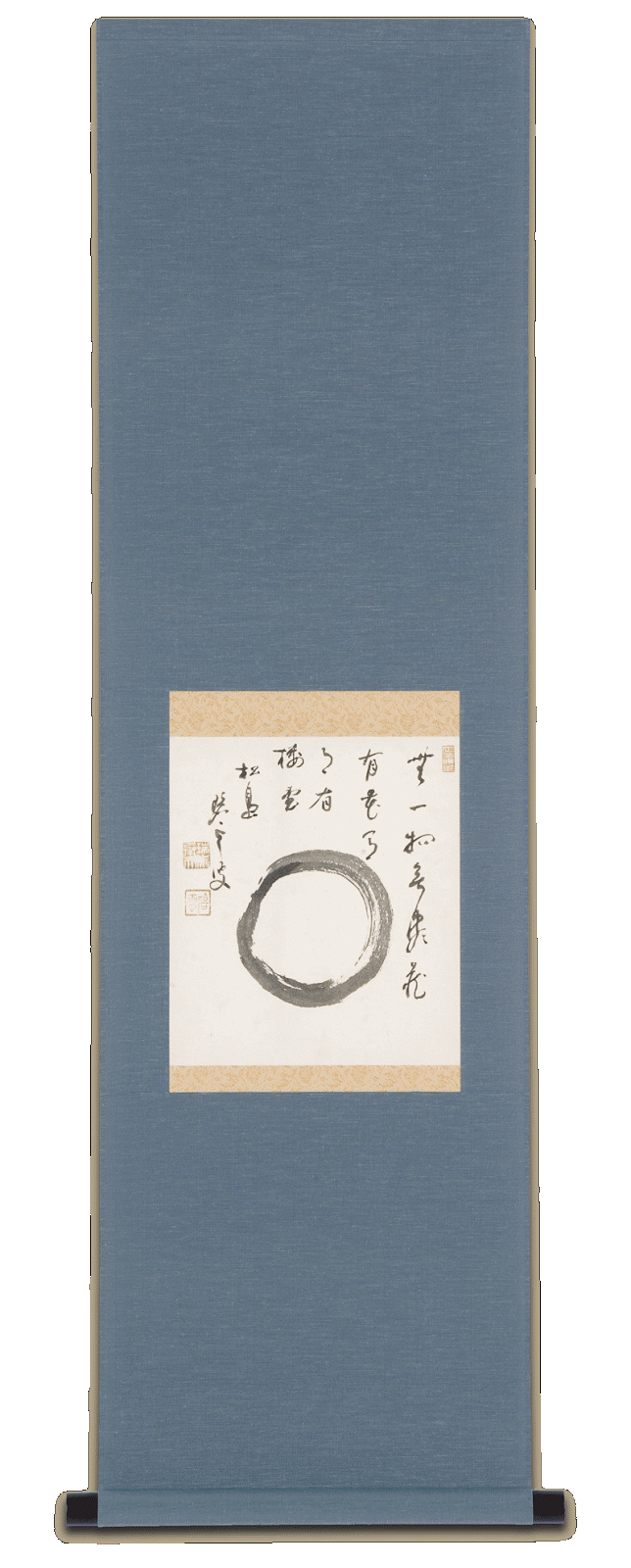
Enso by Miura Joten

Within not one thing are inexhaustible treasures--
there are flowers, there is the moon, there are pleasure pavillions.

~The old fellow Hekiun
of Matsushima.*

Enso by Miura Joten (1872-1958)

Hekiun was Joten's Zen master name; Matsushima is the location of Zuigan-ji, the temple where Joten served as abbot.

This is a "not one thing" enso with  the often used inscription that tells us :"Yes, all things are empty, but that does not mean nothing exists--the world is full of delights that we should enjoy but not cling to." Joten was quite skilled with a brush, and did many interesting and unusual Zenga during  his long life. This is a fine example of his work.

About the Artist

Miura Joten was long-time abbot of Zuigan-ji in Matsushima, and also served as Primate of the Myoshin-ji branch of Rinzai Zen. Joten was a prolific and creative Zen artist

Tuesday, August 20, 2013

A Collection of Zen Enso Art


Belonging to Zen Buddhism, the Enso is a circle, drawn quickly and simply with a brush stroke although years of practice in the art of calligraphy are likely to have preceded the ease with which the symbol can be drawn. The Enso symbolizes eternity, the perfect meditative state, the "no thing," and enlightenment.

What follows is a collection of Zen Enso Circles in a variety of styles and interpretations:

From: Darma Art Fragments
Toyokuni Toshidama
Prints of Japan
Dragon Enso
by Catherine Jao
Enso Blu
Zen Circle
From Misija Komunikacije
Enso Circle
Rainbow Enso
Found at Pics Box
Found at Body of Work
Kusho
Zen Circle by Peter Cutler
Painting After John Cage

Monday, August 19, 2013

The Simplicity Of A Circle


A circle is one of the simplest forms imaginable, yet Zen Buddhists believe this unassuming shape holds great meaning. For centuries, Buddhist monks and artists have created these brushwork circles to express their truth. Some of these artists even hold that the Enso, or Zen circle, is a graphic depiction of enlightenment itself.


Take a moment and contemplate this circle, and notice that it is not perfect, nor does it have to be. Each brush stroke is unique, like the fingerprint of the artist and mind that created it.


Some Enso paintings are loose and elliptical, and some are painted in a slower, more deliberate style. Yet each represents the same thing, the simplicity of the curved line, closing in upon itself. The center is a void of space, blank and empty. Try not to concern yourself with trying to unravel its secrets, rather passively absorb the image, and let it speak directly to your heart. Know that the curved line is the building block of all living things, from the single celled organism from which we all come, to the curve of the mother's womb.


The Zen Buddhists sometimes wrote short passages to accompany these circles, and all gave the same advice in different words. "Make your heart child-like, and you will understand." Take a moment to peruse this small gallery of Enso images. Let the images speak to your heart, and not merely to your mind. Take a little enlightenment into the rest of your day.

From the Daily Om

Sunday, July 21, 2013

The Moon Cannot Be Stolen


A thief entered the little hut of a Zen Master,
but discovered there was nothing to steal.
The Zen Master discovered the thief.
"You have come a long way to visit me," he told the prowler,
"and you should not return empty-handed.
Please take my clothes as a gift."
The thief was bewildered,
but he took the clothes and slunk away.
The Zen Master sat naked, watching the moon.
"Poor fellow," he mused,
"I wish I could have given him this beautiful moon.

- Traditional Zen Koan

Friday, August 10, 2007

I've been thinking

I've been thinking about that old Zen conundrum: what's the sound of one hand clapping? My personal opinion--nothing. You don't have two hands, you don't have any clapping. It's as simple as that. Stars, galaxies, clapping hands, what's the point? The point is that we all need somebody, whether you're a supercluster or a little proton, a yin or a yang. Everybody is hooked into everybody else.

~Geoffrey Neighor, Northern Exposure, Duets,
1993
Related Posts Plugin for WordPress, Blogger...